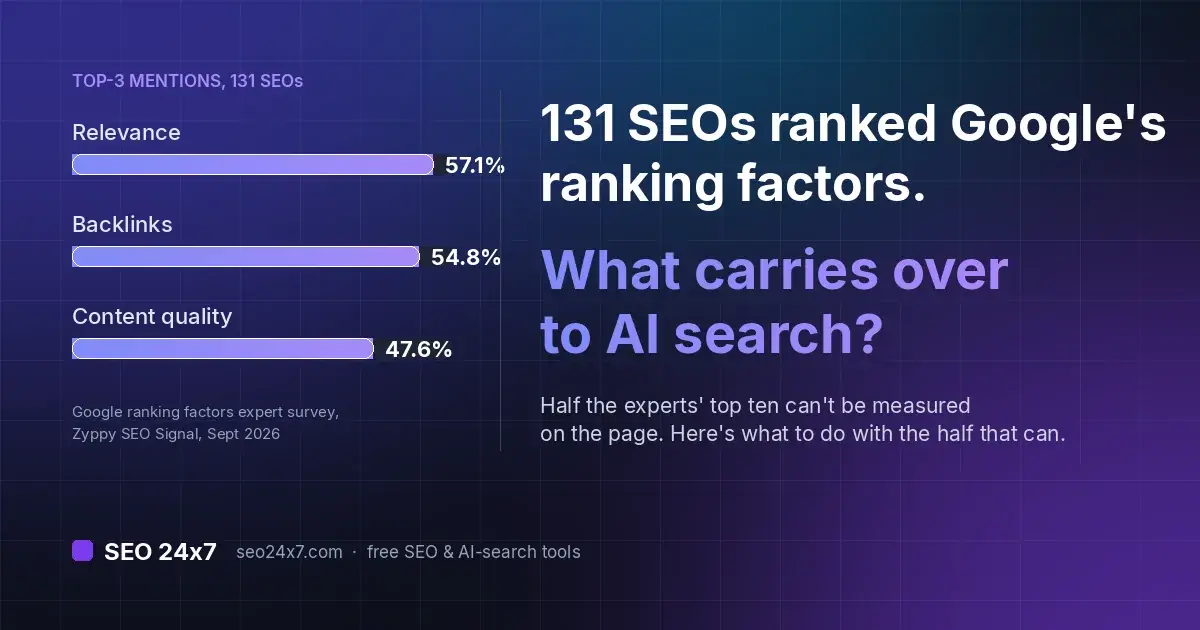
Learn SEO in the order the work actually builds: start with how search engines crawl, index, and rank; then on-page and content; then technical SEO, links, and measurement; and finally AI search visibility. There is no fixed timetable for learning SEO. Progress comes from regular study and hands-on work, and because search changes take several crawl, index, and ranking cycles to settle, you need patience to read the results. This page lays out that sequence so you have a route through the topics instead of a reverse-chronological pile of articles.
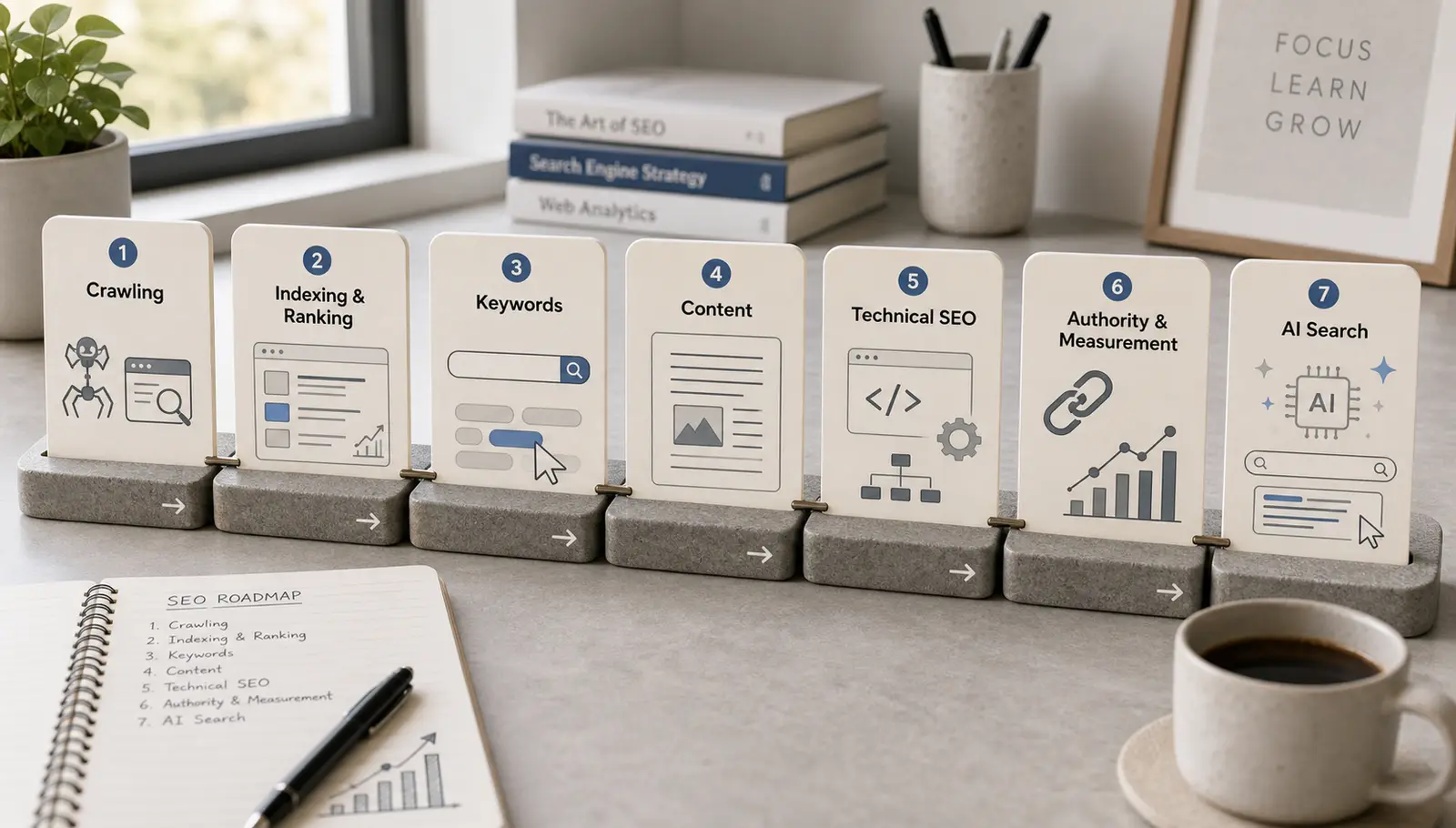
The seven-stage SEO learning path at a glance
- SEO has a natural learning order: crawl and index basics first, then content and on-page, then technical, links, and analytics, then AI search.
- Skipping straight to "ranking hacks" is a common way to stall; the fundamentals are what make the tactics make sense.
- You can practise the entire path on a free site you control, no client or budget required.
- Generative Engine Optimisation (GEO) is a specialisation to add after the core rather than a replacement for it.
- Plan for sustained applied practice; SEO's feedback loop is slow, so results take time to read.
Where should a complete beginner start?
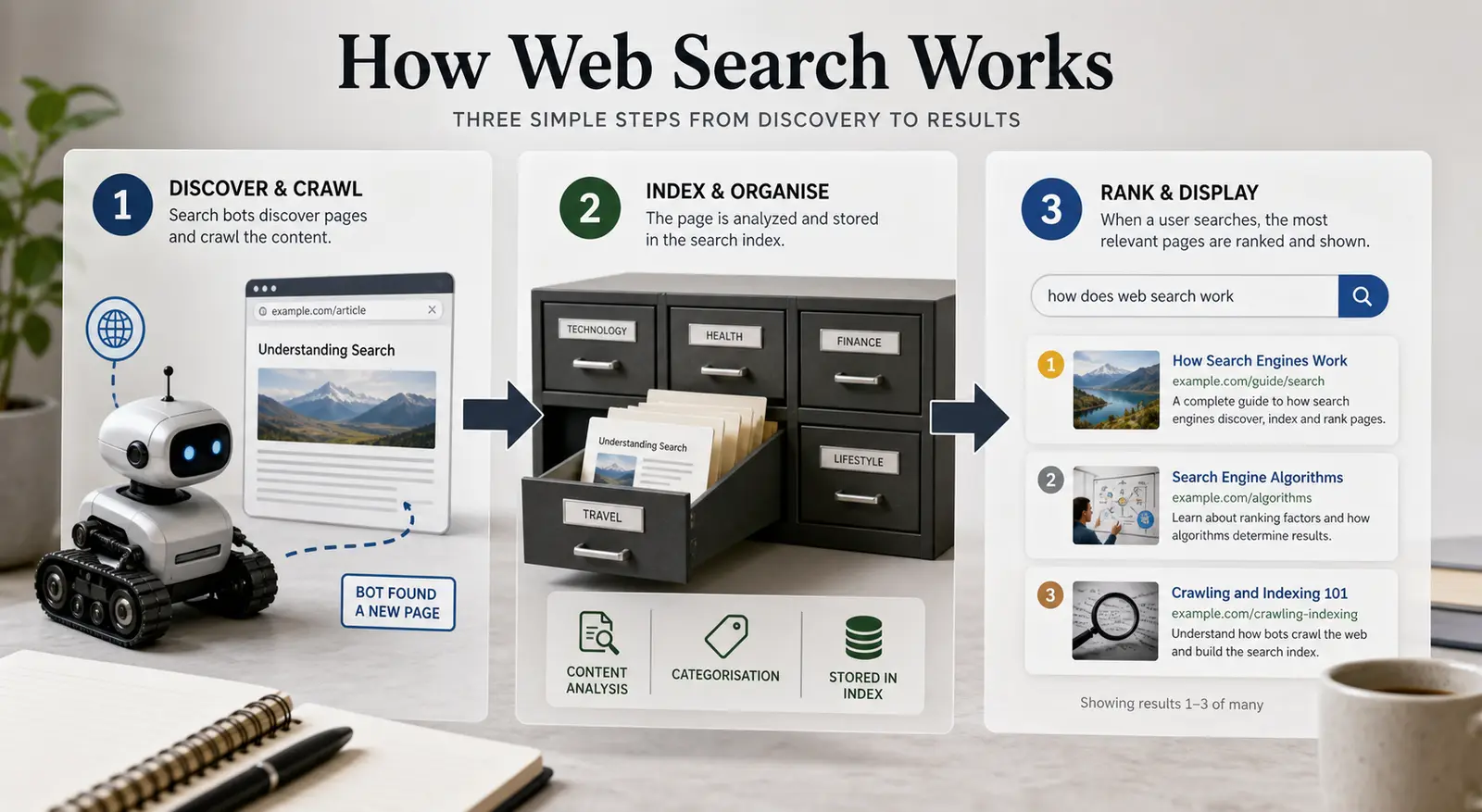
Start with one question: how does a search engine find a page, decide what it's about, and decide where to rank it? Everything else in SEO is downstream of that. Before you touch keywords or backlinks, you want a working mental model of three steps: crawling (a bot fetches your pages), indexing (the engine stores and understands them), and ranking (it orders them for a query).
Use that model to classify each task. A title helps a search engine interpret a page and helps a searcher choose it. An internal link supports discovery and supplies context. Page performance affects usability and can affect search performance. This classification makes it easier to select a relevant action when a page underperforms.
What does the full learning path look like?
Here is the sequence, with each stage assuming the one before it. This page is the curriculum hub that orders those topics and routes you to detailed lessons; each linked post teaches one stage in depth.
1. Foundations
- What you learn: Crawling, indexing, ranking; how results pages are built; search intent
- Why it comes here: These concepts help you diagnose every later SEO task
- Practice task: Publish a page and check its crawl and index status
- Ready to progress when: You can explain the difference between discovery, crawling, indexing, and ranking
2. Keywords and intent
- What you learn: Finding queries, grouping them, matching intent to page type
- Why it comes here: You can't optimise a page until you know the job it does
- Practice task: Map a small query set to distinct intents and page types
- Ready to progress when: Each query points to a clear page type
3. On-page and content
- What you learn: Titles, headings, content depth, internal links, E-E-A-T
- Why it comes here: The largest lever most sites have, and the most controllable
- Practice task: Write a distinct title and H1, and answer the main question first
- Ready to progress when: Your page answers its main question up front and links to related pages
4. Technical SEO
- What you learn: Site structure, robots and sitemaps, page speed, mobile, structured data
- Why it comes here: Removes the blocks that stop good content ranking
- Practice task: Read your robots.txt, validate a sitemap, measure Core Web Vitals
- Ready to progress when: You can tell when a technical issue, not content, is blocking a page
5. Off-page and authority
- What you learn: How links and citations signal trust; earning them honestly
- Why it comes here: Makes sense only once your own pages are worth linking to
- Practice task: Find one page worth linking to and one honest way to earn a citation
- Ready to progress when: Your pages are worth linking to before you pursue links
6. Measurement
- What you learn: Search Console, analytics, reading rank and traffic changes
- Why it comes here: Helps you test explanations against search-performance data
- Practice task: Form and test one hypothesis from Search Console data
- Ready to progress when: You can trace a query or traffic change to a specific cause
7. AI search (GEO)
- What you learn: Getting cited by AI Overviews and answer engines
- Why it comes here: A specialisation layered on a working core
- Practice task: Structure one page for extraction and check whether AI answers cite it
- Ready to progress when: Your core pages are clear, crawlable, and structured for extraction
You do not need to finish a stage before glancing ahead, but resist reordering it. People who start at Stage 5 (chasing links) or Stage 7 (chasing AI citations) before Stage 3 are optimising a page that isn't yet worth ranking.
A quick diagnostic tells you where to focus next. If a page is not appearing in Search Console, stay with discovery, indexing and technical checks. If it appears but attracts irrelevant queries, revisit intent and on-page signals. If it earns relevant impressions but few clicks, inspect the title, snippet and competing result formats. If clicks arrive but the page fails its goal, the problem may sit outside SEO.

What should you learn in each stage, concretely?
Foundations: read how Google describes crawling and indexing in its own documentation, then confirm it by fetching your site the way a bot does. Learn what a SERP is made of now: organic results, featured snippets, AI Overviews, and the rest, because each is a different target.
Keywords and intent: learn to sort queries by what the searcher wants (to learn, to compare, to buy, to find a specific site). Map each intent to a page type. A "how to" query needs a guide; a "best X" query needs a comparison; a brand query needs your money page. Getting this match wrong is why well-written pages sometimes never rank.
On-page and content: this is where you'll spend the most time, and rightly so. Learn to write a title and H1 that are distinct and specific, structure a page around the real questions people ask, and answer the main question in the first sentence rather than after three paragraphs of throat-clearing. Learn internal linking: it's the cheapest ranking lever you fully control.
Technical SEO: learn to read a robots.txt, validate a sitemap, spot pages that are indexed when they shouldn't be, and measure Core Web Vitals. You don't need to be a developer, but you need to recognise when a technical problem, not a content one, is holding a page back.
Off-page and authority: learn how editorial links, expert citations and brand mentions are earned. Start by identifying which of your pages offers evidence, data or a resource another publisher could reasonably reference. Avoid treating outreach volume as a substitute for something worth citing.
Measurement: connect Search Console when the practice site is ready. Choose a regular review interval, record impressions, clicks, queries, and indexing changes, and compare each review with your change log.
AI search (GEO): structure your clearest pages so answer engines can extract and cite them, then check whether AI Overviews and answer engines actually reference them. This builds on the on-page and technical stages rather than replacing them, and the expanded lesson is below.
How long does it actually take to learn SEO?
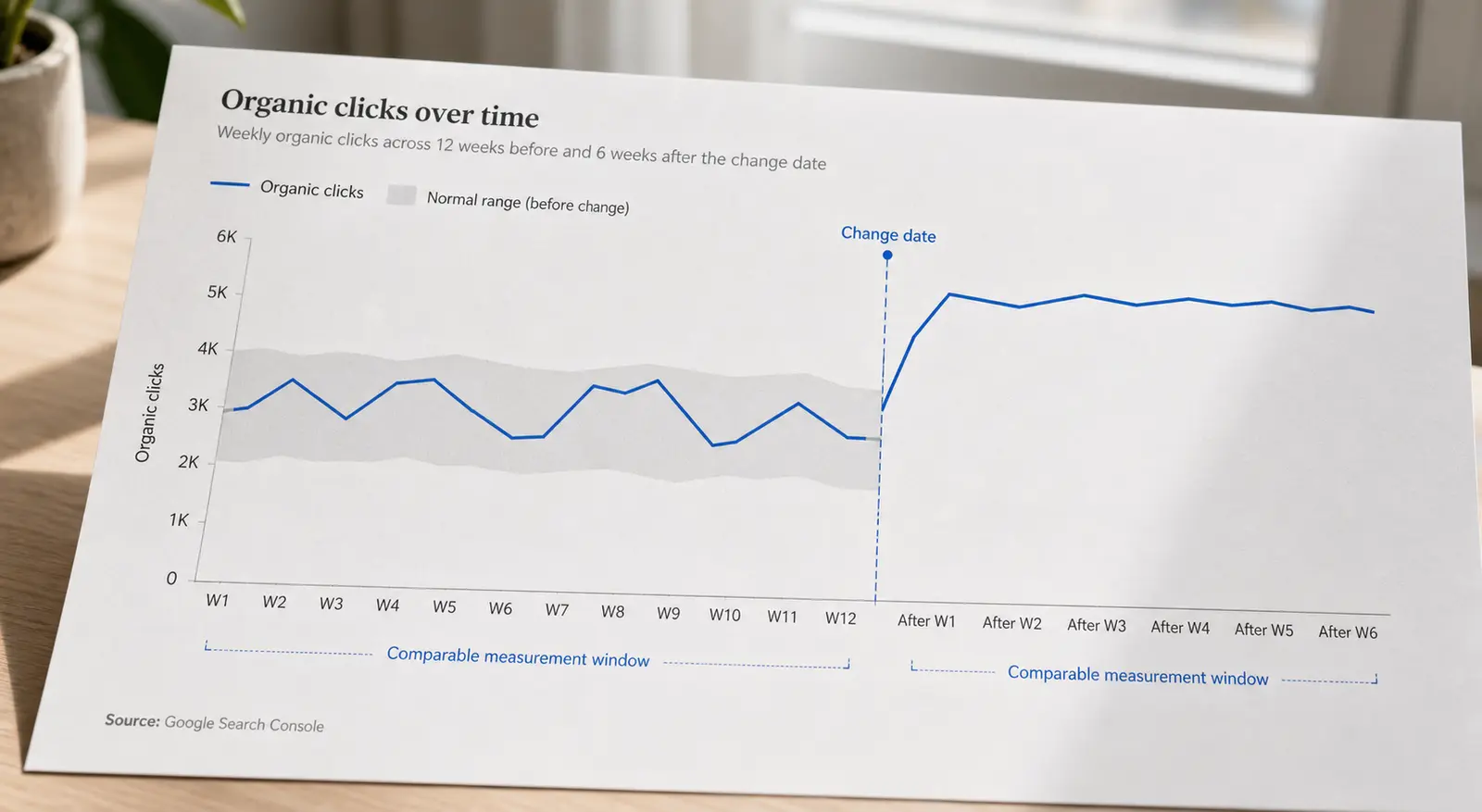
There is no dependable completion date for learning SEO. Progress depends on how often you practise, the site you use, and the problems you encounter. Search changes also become measurable at different speeds, so record each change and wait for enough crawl, index and performance data before judging it.
This is also why passive course-watching underperforms. The people who learn fastest run many small experiments on a real site and watch what each one does over time. Keep a written log of what you changed and when, and expect the first results to feel ambiguous.
How do you practise SEO without a client or a budget?
Build a small site you fully control and treat it as a lab. A free blog on a niche you actually know is enough. On it you can practise every stage of the path end to end: publish content targeting real queries, structure and interlink it, add schema, watch it get indexed, and read the results in Search Console. Watching how a page moves from discovery to indexing gives you practical evidence of how the process works.
Free tools cover most of what you need while you learn. SEO 24x7's tools let you rehearse the specific skills each stage needs: preview how a page looks in results with the SERP preview tool, check title and description length with the meta previewer, generate valid structured data with the schema generator, test load speed with the speed test, and run a broad on-page check with page check. Use each tool on a page you control, record what it reports, make one relevant change, and compare the result at the next review.
When should you learn AI search and GEO?
AI Overviews and answer engines can cite web sources, making citation visibility a useful advanced topic. Treat it as an extension of core SEO: publish direct, well-supported answers, make the page crawlable, and organise information so readers and retrieval systems can interpret it.
Once your core is solid, continue with our guides to what GEO is, how GEO differs from SEO, earning visibility in AI Overviews and answer engines, and getting cited by ChatGPT.
What mistakes slow most beginners down?
A few patterns cost people the most time:
- Collecting tactics before building the mental model, so they can't tell which tactic a given problem calls for.
- Chasing backlinks before the pages are worth linking to.
- Changing many things at once, then being unable to tell which change moved the needle.
- Expecting results in days and abandoning changes before crawling and indexing have caught up.
- Optimising for a keyword while ignoring the intent behind it, so the page ranks for nothing.
- Treating GEO as a shortcut that replaces fundamentals rather than a layer on top of them.
Avoiding these isn't about talent; it's about respecting the order of the path and the slowness of the feedback loop.
Your first exercise: publish and inspect one crawlable page
Create one page on a topic you understand. Make sure it is linked from another page, submit or inspect it in Search Console, and record when it is discovered and indexed. Then rewrite its title or internal links, record the change, and review the resulting query and impression data before moving to the next stage. Use the SEO 24x7 free tools and topic guides when each exercise calls for them, and check your reasoning against the community when you want a second read.