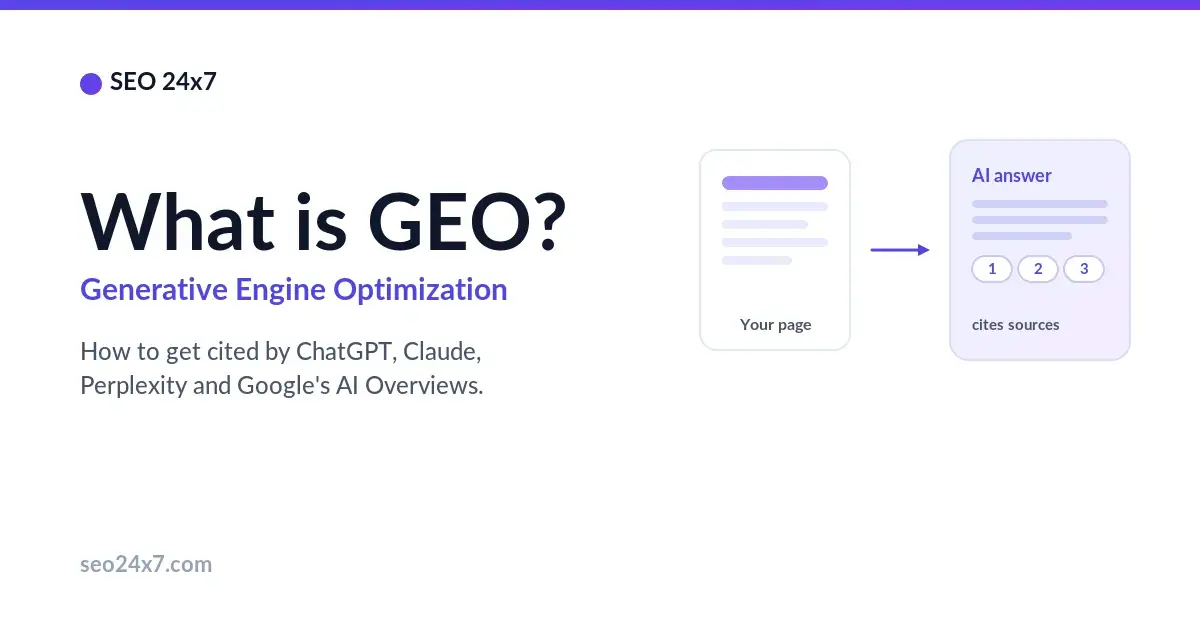
Generative engine optimization (GEO) is the practice of structuring, writing and marking up your content so that AI assistants — ChatGPT, Claude, Perplexity, Google's AI Overviews and Gemini — cite it when they answer a question. Where classic SEO competes for one of ten blue links, GEO competes for one of the two-to-seven sources an AI model names in a single answer.
GEO vs SEO: the goal has changed
Traditional SEO optimises for a position in a list of links, hoping to earn a click. GEO optimises for inclusion in the AI-generated answer itself. The click may never happen — the citation is the win, because the assistant has handed your information (and often your brand) straight to the user. This is not a niche concern: AI-referred website sessions jumped 527% year over year in the first half of 2025. GEO does not replace SEO; it builds on the same foundations of clear, authoritative, well-structured content.
Why GEO matters now
AI search is growing fast while competition for citations is still low — the businesses that structure for it now capture citation share early. And the rules of authority are shifting: research finds that brand mentions correlate roughly three times more strongly with AI visibility than backlinks do (0.664 vs 0.218). Being talked about across the web now matters more to an AI than the raw number of links pointing at you.
How AI engines pick what to cite
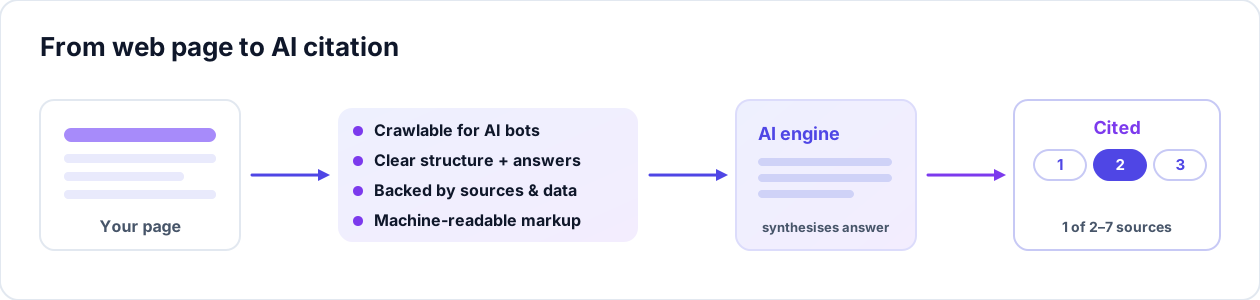
AI engines retrieve a handful of pages and synthesise an answer from them. They favour content that is clearly structured, genuinely authoritative, tightly scoped to the question, and easy for a machine to read. Three habits move the needle most.
1. Structure for synthesis
Use descriptive H2 and H3 headings, short paragraphs, lists and tables. Content with clear formatting is 28–40% more likely to be cited. Open each section with an "answer capsule" — a direct, 40–60 word answer to the question the heading implies — and add an FAQ section, because question-and-answer formatting mirrors how people actually query AI.
2. Earn trust with evidence
Princeton's GEO research measured which tactics increase how often AI engines cite a page. Citing external sources raised visibility by up to 115% for lower-ranked content, adding statistics by 41%, and adding quotations by 28%. The lesson: cite your sources, back claims with data, and quote real experts.
3. Be machine-readable
Spell out the facts in a form machines can parse. Add Schema.org structured data so engines understand who and what a page is about, publish an llms.txt file that summarises your site for AI, and make sure the right AI crawlers can actually reach your pages. Give every page a single, clear primary entity so engines never have to guess what it represents.
A starter GEO checklist
- Add structured data with the Schema Generator.
- Publish an llms.txt with the llms.txt Generator.
- Allow search and citation bots with the AI Crawler Manager.
- Open every section with a 40–60 word answer capsule, and add an FAQ.
- Cite sources, add statistics, and quote experts to earn trust.
- Give each page one clear primary entity (entity SEO), not just a keyword.
Frequently asked questions
Is GEO replacing SEO?
No. GEO builds on SEO. The same clear, authoritative, well-structured content that ranks in Google also gets cited by AI assistants, so the smart move is to do both rather than choosing between them.
How long does GEO take to work?
New content typically starts appearing in AI answers within three to six months. Engines that retrieve in real time, like Perplexity, can reflect quality improvements faster; building authority takes the longest, often six to twelve months.
Do I need backlinks for GEO?
Less than you might think. Brand mentions correlate about three times more strongly with AI visibility than backlinks do, so being referenced and talked about across the web matters more than raw link count.
Ready to start? Work through the checklist with our free SEO and AI-search tools — no sign-up required.