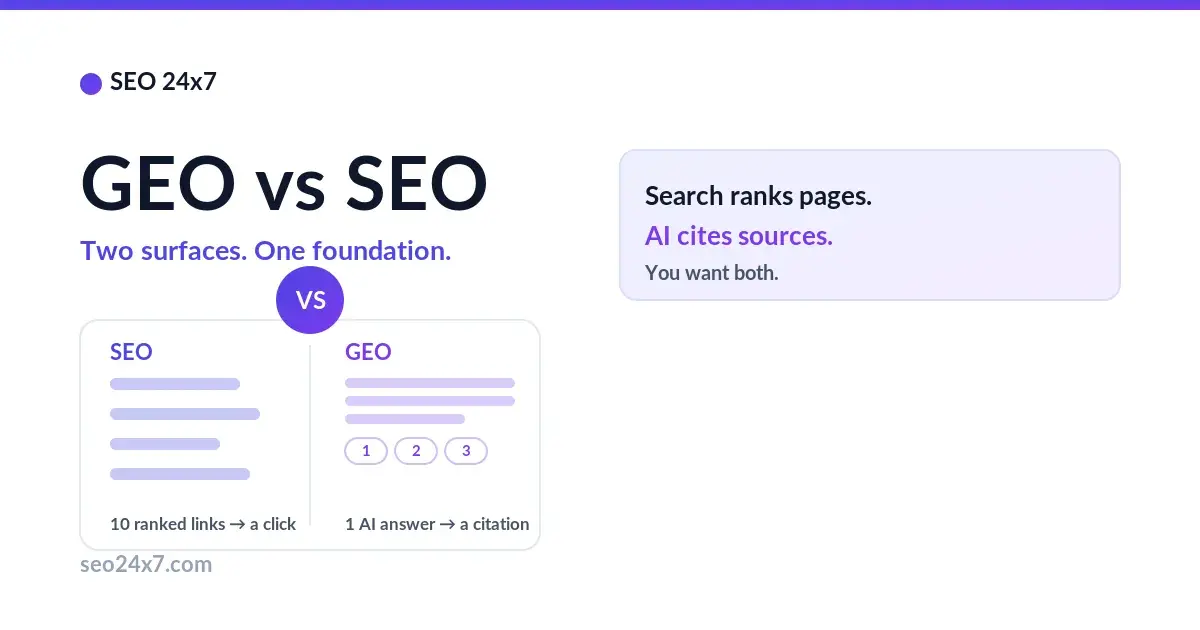
SEO earns a ranking in a list of links; GEO earns a citation inside an AI-generated answer. They share the same foundation — clear, credible, well-structured content — but optimise for different surfaces. In 2026 you need both: search still drives most traffic, while generative engine optimization captures the fast-growing share of journeys that end inside ChatGPT, Perplexity or Google's AI Overviews.
What SEO does
Search engine optimization (SEO) is the practice of improving a page so it ranks higher in search results like Google and Bing. The goal is a position on the results page that earns a click. It rewards relevant keywords, helpful content, fast and crawlable pages, and links from other sites.
What GEO does
Generative engine optimization (GEO) is the practice of structuring content so AI assistants cite it when they answer a question. Instead of ranking among ten links, you compete to be one of the two-to-seven sources a model names in its reply. Our field guide to GEO covers the fundamentals in depth.
The key differences
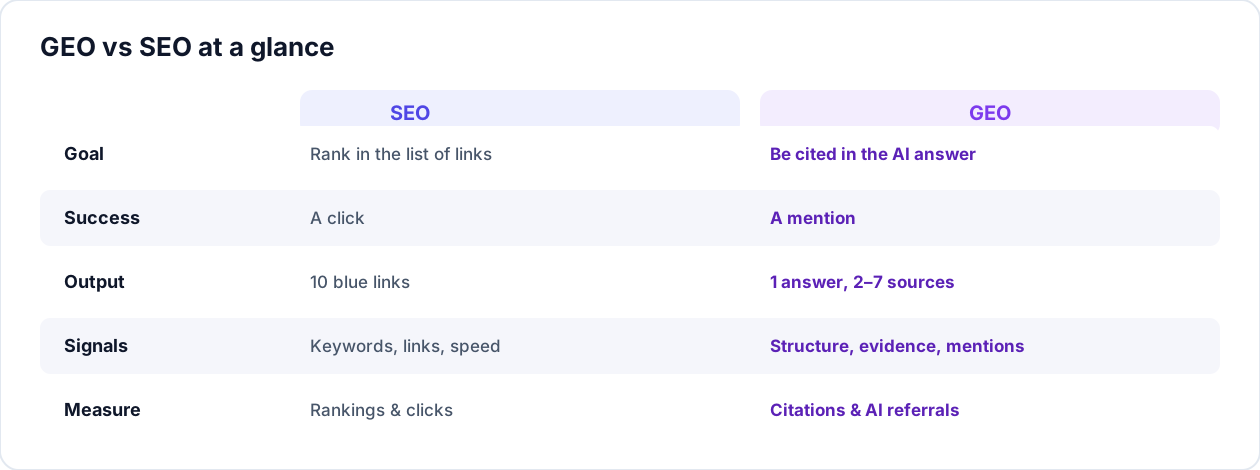
- Goal: SEO wants a ranking position; GEO wants to be cited inside the answer.
- Unit of success: SEO measures the click; GEO measures the mention, which may happen without any click at all.
- Output surface: a page of ten blue links versus a single synthesised answer with a short list of sources.
- What moves the needle: SEO leans on keywords, links and technical health; GEO leans on clear structure, evidence, brand mentions and machine-readable markup.
- How you measure it: SEO tracks rankings and organic clicks; GEO tracks AI citations and referral traffic from assistants.
What they share
More than the differences suggest. Both reward content that is genuinely helpful, clearly written and well organised, published on a site that loads fast and lets crawlers in. GEO does not throw out the SEO playbook — it extends it. A page that already earns featured snippets in Google is well placed to be pulled into an AI Overview, because the qualities that win a snippet are the same ones a model looks for when choosing a source.
Do you need both?
Yes. Search still sends most of the web's traffic, so abandoning SEO would be a mistake — but a growing share of journeys now end in an AI answer, and those answers are being shaped right now while competition is low. The efficient move is to keep doing solid SEO and layer GEO on top: add structured data, publish an llms.txt, allow citation crawlers, and write in clear, well-evidenced sections. Our free SEO and AI-search tools help with each of those steps.
Frequently asked questions
Is GEO just SEO rebranded?
No. They share foundations, but GEO targets a different surface — the AI-generated answer rather than the ranked list — and adds tactics SEO never needed, such as llms.txt files and writing for citation rather than clicks.
Will GEO replace SEO?
Not in the near term. Traditional search still drives the majority of web traffic. GEO is best treated as an additional channel that grows alongside search, not a replacement for it.
Where should I start?
Start with the SEO basics you may already have, then work through the GEO starter checklist: structured data, an llms.txt file, crawler access, answer capsules and cited evidence.