Cyrus Shepard and Dawn Shepard at Zyppy SEO surveyed 131 SEO professionals on more than 100 possible Google ranking factors and published the results on 9 September 2026. Their headline finding is that relevance to search intent, backlinks and content quality still sit at the top, and that meta descriptions have almost no believed effect on rankings. Our read is that roughly half of the experts' top ten cannot be measured from the page itself, and that the half you can measure matters even more for AI answers than it does for Google's ten blue links. The full results, expert comments and methodology are on the Zyppy SEO Signal newsletter, and this article is a response to that work, not a substitute for it.
The short version
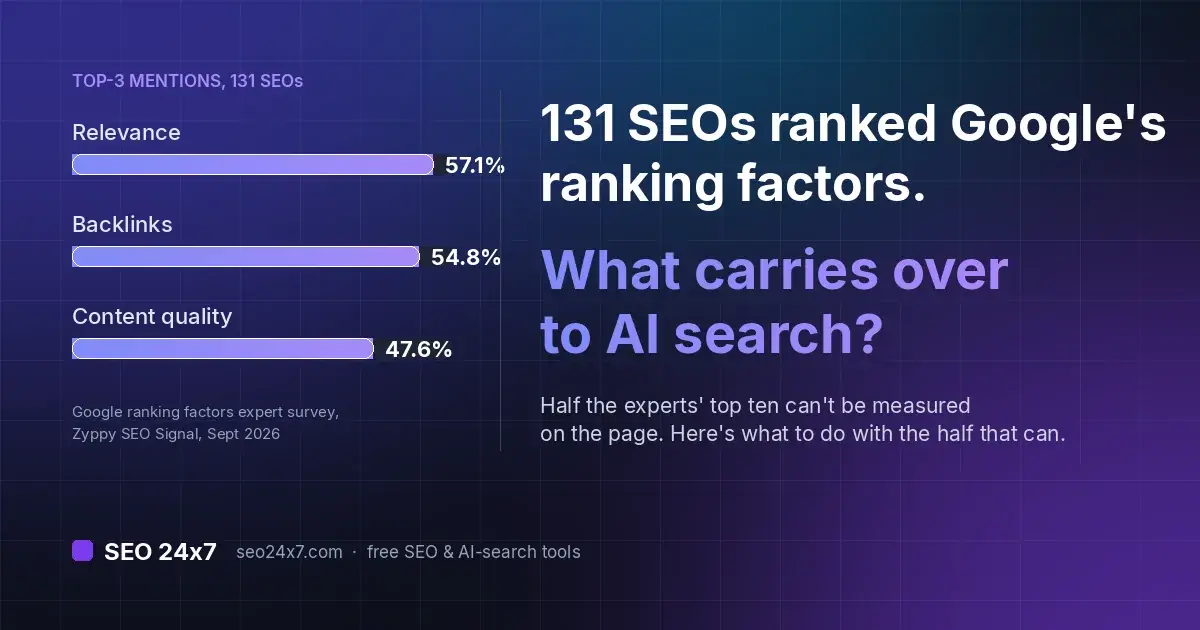
- Search intent match was the single highest-rated factor. Relevance was named a top-three factor by 57.1% of respondents, backlinks by 54.8% and content quality by 47.6%.
- Five of the experts' top ten are off-page or behavioural: backlinks, authority, click signals, brand and user satisfaction. No on-page tool, ours included, can score those.
- Meta descriptions were rated close to inert for ranking. Google's own documentation only describes them as snippet material, so treat them as click-through work, not ranking work.
- Google says nothing extra is required to appear in AI Overviews or AI Mode. The factors that carry over are the on-page ones: intent match, extractable text, crawl access and internal links.
- The survey measures belief, not causation. It is a well-run snapshot of professional consensus, and it should be read as one.
What did the survey actually find?
The survey asked 131 practitioners to score 103 predefined factors on a seven-point scale, from strongly positive to strongly negative, producing 13,665 individual ratings. A separate open question asked each respondent to name their three most important factors, and the percentages quoted here come from that open question.
Relevance led with 57.1%, backlinks followed at 54.8% and content quality came third at 47.6%. Authority and trust, behaviour and click signals, brand signals, user satisfaction, technical health, topical authority and internal links completed the top ten. On the scored list, search intent match was the clear winner across all 100-plus factors. Original research and first-party data topped the content quality group, and links from trusted, topically relevant sites topped the link group. Spam links and pogo-sticking back to the results page were among the strongest negatives.
The disagreements are as useful as the consensus. Experts split on site speed and Core Web Vitals, with views ranging from calling them the most over-rated thing in SEO to treating them as decisive for e-commerce and close to irrelevant for a local business. They split on AI-generated content, with the dividing line being human review and added value rather than the tool used. Technical SEO was described repeatedly as table stakes: bad technical work hurts, but good technical work will not lift mediocre content on its own.
If you want the full rankings and the individual expert comments, read the original. We have deliberately not reproduced their tables.
Which of these factors can you measure on your own page?
About half. That is the number most SEO tools, including the free ones on this site, would rather you did not think about.

Relevance, content quality, technical health, internal links and topical authority all leave evidence in the HTML. A crawler can check whether a page answers the query it targets, whether the text is original and current, whether the site can be crawled and indexed, how pages link to each other and whether a site covers a topic in depth. Those are the checks an on-page audit can run with a straight face.
Backlinks, authority, click behaviour, brand signals and user satisfaction do not live on the page. They live in other people's websites, in Google's logs and in search behaviour nobody outside Google can see in full. A tool that claims to score "authority" from the page alone is estimating, and usually estimating from a third-party metric that Google does not use.
This matters for how you read any audit score, including the one our Page Checker produces. A high on-page score means the half you control is in order. It says nothing about the half that is earned.
Does the meta description finding change anything?
It changes the label on the work, not the work itself.
The experts rated meta descriptions so low that most do not believe they affect ranking at all. That lines up with Google's snippet documentation, which says Google primarily uses the page content to build the snippet and may use the meta description when it describes the page better than the content does. Nothing in that documentation connects the tag to ranking position.
So keep writing them, because a good snippet earns the click, and a click is the only reason the ranking mattered. But stop counting a meta description rewrite as ranking work in a report. When an audit, ours included, flags a missing description, the honest reading of that flag is "your snippet is being written for you", not "your rankings are suffering".
Which Google factors carry over to AI answers?
The on-page half carries over almost intact. The off-page half carries over unevenly, and the behavioural signals mostly do not exist in the same form.
Google's documentation on AI features, last updated in December 2025, says there are no additional requirements to appear in AI Overviews or AI Mode and no special optimisation is needed. The fundamentals it lists are crawlability, internal linking, page experience, keeping important content in text rather than images or video, and accurate structured data. Every item on that list is on-page.

Relevance transfers strongest. An answer engine retrieves passages, not pages, so a page that answers one question directly in its first paragraph is easier to quote than a page that circles the topic for six hundred words. Content quality transfers in the same way the survey describes it: original data and first-party observations get cited because they are the only thing an AI cannot generate itself.
Technical health changes character. In Google search it is a floor. For AI answers it is a gate, because a site that blocks GPTBot, ClaudeBot or PerplexityBot in robots.txt is not table stakes, it is absent. You can check which AI crawlers a site allows in seconds with the robots.txt checker, and set the rules deliberately with the AI crawler manager.
Backlinks and brand are where the evidence is thinnest and the anecdotes are loudest. One respondent reported that a client's ChatGPT visibility rose fourfold the week after a Reuters mention. That is a single, unverified observation, and the survey presents it as one. The plausible mechanism is that assistants lean on the same trusted sources and entity knowledge that links and branded search already feed, which would make a strong link profile more valuable for AI visibility, not less. Treat it as a hypothesis worth testing on your own brand, not a finding.
Click and satisfaction signals largely disappear. There is no results page to pogo-stick back to inside a generated answer, and the assistant does not watch you read the cited page. Whatever replaces those signals is not something the survey measured, and the authors have said a separate survey on Google's AI answers is coming.
What should you do differently this quarter?
Four things, in order of how much of the survey's evidence supports them.
Audit intent match page by page, because it was the strongest factor on both lists. For each page, write the one question it answers and check the first paragraph answers it. If the first paragraph is a preamble, rewrite it. The Readability Checker will show you where sentences run long enough to bury the answer.
Confirm AI crawlers can actually reach you. Run your domain through the robots.txt checker and look at the AI bot rows. Sites sometimes block the very crawlers they are trying to get cited by, through a CMS or CDN default nobody chose on purpose.
Move one page a month from summary to source. The survey put original research and first-party data at the top of the content quality group. A page with a number you measured beats a page that explains a concept everyone else has explained.
Reclassify meta description work as snippet work. Keep doing it, report it correctly.
Where the survey is weakest
It measures what experienced people believe, not what Google does. Consensus among 131 practitioners is valuable precisely because they have watched thousands of sites move, but it can also be consensus about a shared model that is wrong in places. The authors are clear about this and frame the results as a reference for current professional opinion.
The respondents self-selected, the scale captures direction but not magnitude, and the survey is about Google's classic results rather than AI answers or other engines. None of that is a criticism of the work. It is the boundary of what it can tell you, and the boundary is worth knowing before you change a strategy on the strength of it.
Attribution. The survey, its methodology, all percentages quoted here and the expert comment paraphrased above are the work of Cyrus Shepard and Dawn Shepard, published as the 2026 Google Ranking Factors Expert Survey on the Zyppy SEO Signal newsletter on 9 September 2026. We have summarised a small part of it with attribution and linked to the original throughout. Read the full piece at signal.zyppy.com. Google documentation referenced: AI features and your website and Control your snippets in search results, both checked 10 September 2026.