To earn visibility in Google's AI Overviews — and in AI Mode, Perplexity and Copilot — you have to be more than highly ranked; you have to be clearly citable. Inclusion depends on three things you can influence: source clarity, passage-level relevance and topical depth, all sitting on clean technical access. This is the AI-Overview side of generative engine optimization.
For most of SEO's history the goal was simple: rank a page high enough that searchers click through. That still matters, but for a growing set of informational queries the first thing a user sees is a synthesised answer with cited sources, not a list of links. The audit question changes — it is no longer enough to ask whether a page ranks; you also have to ask whether its clearest passages are good enough to be cited.
This guide focuses on what practitioners can actually influence: source clarity, passage structure, entity signals, technical access and topical authority.
Why rankings alone no longer guarantee visibility
Google's AI Overviews aggregate answers from multiple sources, and inclusion is not decided by ranking position alone. A page in position three may never be cited; a page in position twelve sometimes is. Selection depends on how clearly the page answers the specific question being synthesised, how reliably Googlebot can reach the content, and how well the source is recognised as an authority on the topic.
Other answer engines — Bing Copilot, Perplexity and Google's AI Mode — follow similar logic, though each weights the signals differently. The habits that win one tend to help across all of them; our guide to getting cited by ChatGPT, Perplexity and AI Overviews goes platform by platform.
The implication: ranking work is still the foundation, but ranking without optimising for citation can mean losing the most visible spot on the page.
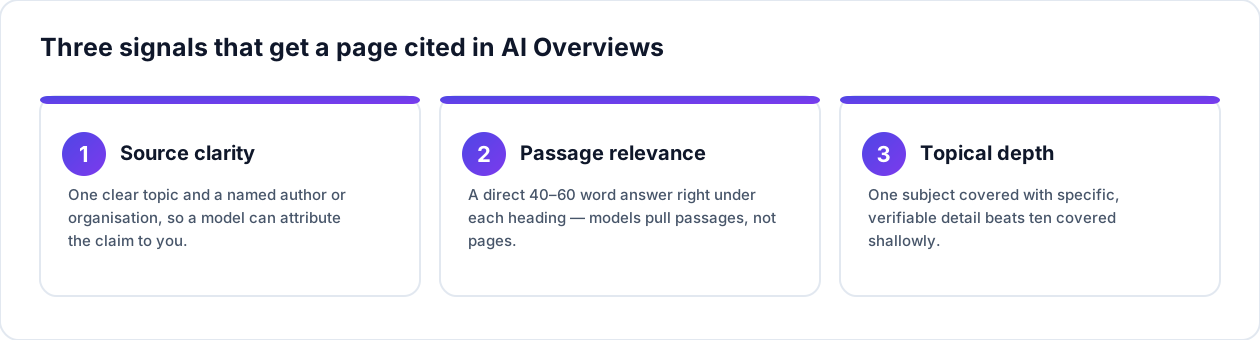
The three signals that drive AI Overview source selection
These systems are trying to synthesise a reliable answer and attribute it correctly. Their selection behaviour clusters around three factors.
Source clarity. An AI system needs to confidently attribute a claim to a page. Pages with one unambiguous topic, a clearly identified author or organisation, and focused content are easier to cite.
Passage-level relevance. These systems pull at the paragraph level, not the page level. A 2,500-word article that buries its answer in the eighth section is a weaker candidate than a shorter piece that leads with it. Aim for self-contained answer passages of 40–60 words for key definitions and direct responses.
Topical depth over breadth. A page that covers one topic with specific, verifiable detail is more useful than one that summarises ten shallowly. Depth signals genuine knowledge; shallow coverage signals a pass-through source.
Entity clarity: making your content unambiguous
Entity SEO ensures AI systems can confidently identify what your content is about and who produced it. For AI Overviews it matters because the system resolves a citation chain: this claim came from this page, which comes from this organisation.
- Keep a consistent identity for your organisation or author across your site, your structured data and external mentions.
- Give each page one clearly defined primary topic. If a page could belong to two topic areas unchanged, it needs sharper focus.
- Use structured data — Organisation, Article with an author, or Person schema — to make those relationships machine-readable rather than left to inference.
If your brand name is shared with an unrelated business or concept, address the disambiguation directly in your content rather than hoping surrounding signals are strong enough.
Structuring content for passage-level extraction
Because AI systems extract passages, section-level structure matters as much as page-level structure. Each section should stand alone as an answer: the heading names the question, the opening sentence delivers the answer, and supporting evidence follows. When a model pulls a single paragraph, it should get a complete, attributable answer — not a fragment that only makes sense in context.
Two patterns to avoid: leads that hedge ("there are many factors to consider" pushes the useful content down — state the answer first), and imprecise conditionals ("it depends" is thin; when something varies, say why it varies).
Weak: "There are several reasons canonical tags matter for indexing." Strong: "A canonical tag tells Google which version of a duplicate page to treat as preferred. It doesn't guarantee indexing, but it consolidates ranking signals when Google respects it." The strong version is a complete, citable passage; the weak one is a preamble that forces a model to keep reading.
Technical access: what blocks AI Overview inclusion
AI Overviews are built from content Google has crawled and indexed, so access problems exclude a page entirely. Check for:
- robots.txt rules blocking Googlebot from pages meant to be indexed
- noindex directives left on after a staging-to-production migration
- core content loaded via JavaScript that Googlebot doesn't render reliably
- login walls or paywalls hiding the main content
The Search Console URL Inspection tool is the fastest diagnostic. Separately, decide which AI crawlers you allow — keep search and citation bots in, and use our AI Crawler Manager to generate the robots rules. Publishing an llms.txt gives those models a clean summary of your key pages too — here's what llms.txt is and how it helps.
Structured data that signals reliability
Structured data doesn't guarantee inclusion, but it gives explicit signals about your content's structure and authorship. Article schema with a clear author and publisher strengthens authorship; HowTo makes steps machine-readable; FAQPage marks up question-and-answer pairs, which matches how answer engines extract passages. The catch: markup must reflect what is actually on the page — claiming an FAQ that users can't see violates Google's guidelines and damages reliability rather than building it.
Building topical authority across your site
One optimised page creates a presence; consistent, accurate coverage of a topic builds the authority AI systems weight when choosing between candidates. Topic clusters work for a concrete reason: when a model synthesises an answer on a subject where you've published several specific, accurate pieces, it has more evidence of your reliability than if you have one general overview and nothing else. The bar is depth, not volume — thin pages added only to extend keyword range add noise to your topical signal.
Measuring your AI Overview presence
This changed recently. In June 2026 Google added dedicated generative-AI performance reports to Search Console, so you can now see impressions from AI Overviews and AI Mode, broken down by page, country, device and date. The limitation: it is impressions only — no clicks, CTR or query data yet — and it is rolling out gradually (UK site owners first). You can see visibility, but not its traffic value.
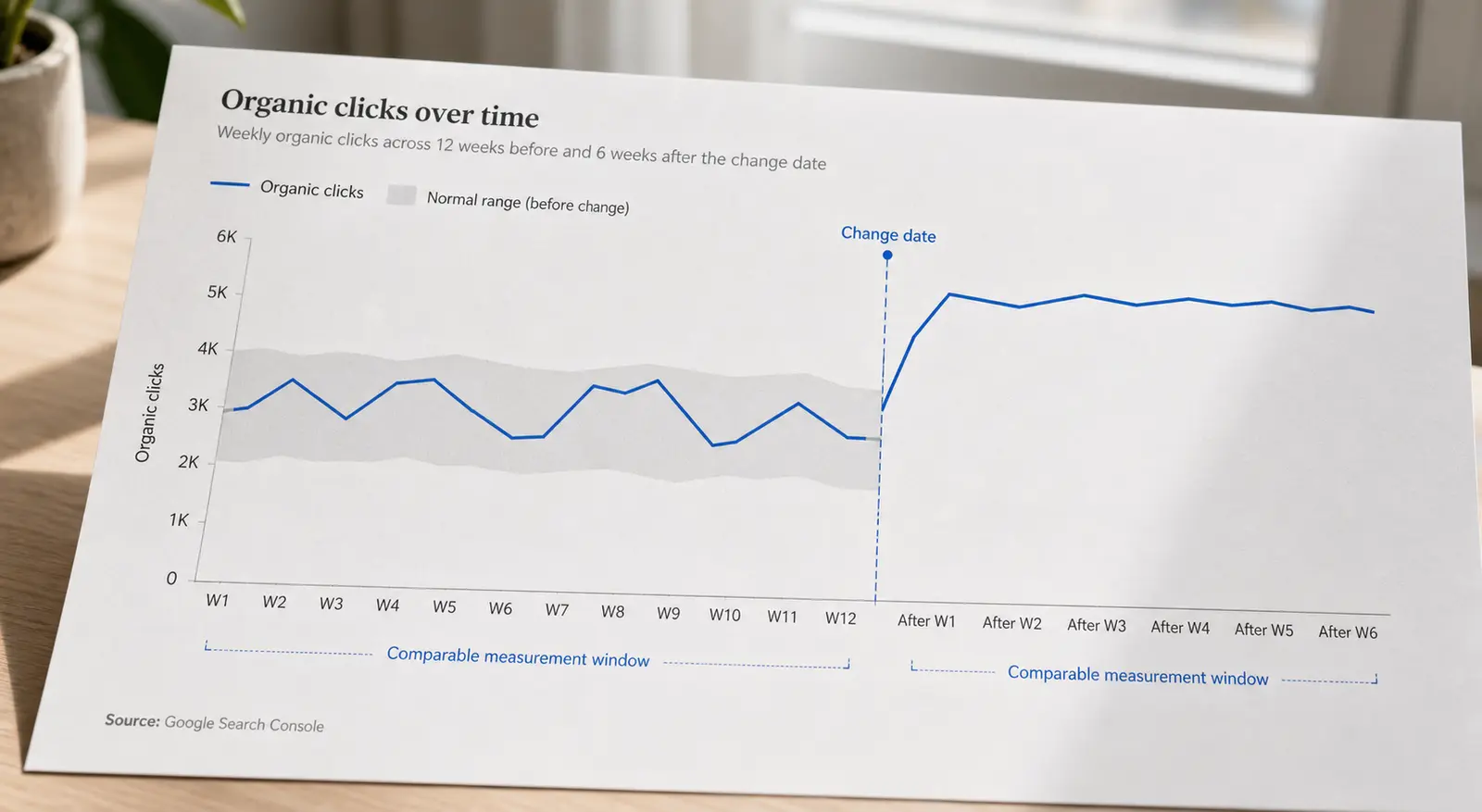
So the indirect signals still matter: pages that previously drove strong informational traffic but now show falling clicks without a ranking drop are often cases where an AI Overview is answering the query without a click. Impressions holding steady while clicks fall is the specific pattern to watch.
Manual checks remain the most direct method: run your target queries on desktop and mobile, note which trigger Overviews, and check whether you're cited. For large libraries, sample a representative set of your highest-impression informational queries on a regular schedule rather than checking every query.
Where to start if you're auditing a site today
If you're beginning AI-search optimisation rather than doing a full overhaul, three checks give the best return for the time invested:
- Identify the 10–20 informational queries where AI Overviews already appear for your targets, and check whether your content is currently cited.
- For each of those pages, check whether the direct answer appears within the first two paragraphs of the relevant section.
- Verify your structured data (Article or FAQPage where appropriate) is implemented and returns no errors in Google's Rich Results Test.
Track it in a simple sheet — one row per target query, with columns for whether an AI Overview appears, who's currently cited, your ranking URL, whether your direct-answer passage sits in the opening lines, any entity or schema gap, and the next action. For example, for "how does canonicalisation affect indexing" you might find an Overview citing three domains — none yours — while your guide ranks position 8 with the definition buried in section four and no author in its Article schema; the fix is to move the answer to the opening paragraph and add Article schema with an author. Where you rank but aren't cited, the direct-answer and schema columns almost always surface the gap.
Frequently asked questions
Do AI Overviews kill my clicks?
They can reduce clicks on informational queries, but being the cited source keeps your brand in front of the user and can still earn qualified clicks. Track impressions against clicks in Search Console's new AI report to see the real picture for your pages.
Should I block AI Overviews?
You can limit AI features with snippet controls and crawler rules, but blocking usually removes you from the Overview without bringing the old clicks back. Most sites are better served optimising for citation. Use the AI Crawler Manager to choose deliberately.
Is this the same as GEO?
Largely, yes. Earning AI Overview citations is the search-engine slice of generative engine optimization — the broader practice of being cited across all AI assistants.
SEO 24x7 is a community for AI search, entity SEO and structured data. Work through these checks with our free SEO and AI-search tools — no sign-up required.