Keyword research is the process of finding the exact phrases people type into search, then choosing the subset you can realistically rank for and that will bring the right visitors. Do it in five moves: gather a handful of seed topics, expand each into hundreds of real queries, sort those queries by search intent, score them for competition and demand, then assign each keyword group to one page. A term is "worth targeting" only when it has genuine search demand, matches something you can offer, and sits at a difficulty your site can actually reach.
Key takeaways
- A keyword worth targeting needs three things at once: real search demand, intent you can satisfy, and difficulty within reach of your site's current authority.
- Start from seed topics you already understand, not from a blank keyword tool.
- Group by intent first (informational, commercial, transactional, navigational); intent decides page type before volume ever matters.
- For many new sites, specific queries with weaker competing pages are a practical starting point. Confirm that advantage in the live results, because a long query can still be highly competitive and a broader term can occasionally expose a reachable gap.
- Start with one dominant search need per page. Combine queries when the same page format and substantially similar search results satisfy them; split them when the result sets or required page formats differ.
What makes a keyword "worth targeting"?
A keyword earns a place on your list when it clears three tests together. First, demand: enough people search it that ranking is worth the effort. Second, relevance: you can create the page the searcher actually wants, not a stretch. Third, reachability: the results already ranking are pages you could plausibly compete with given your site's age and link profile.
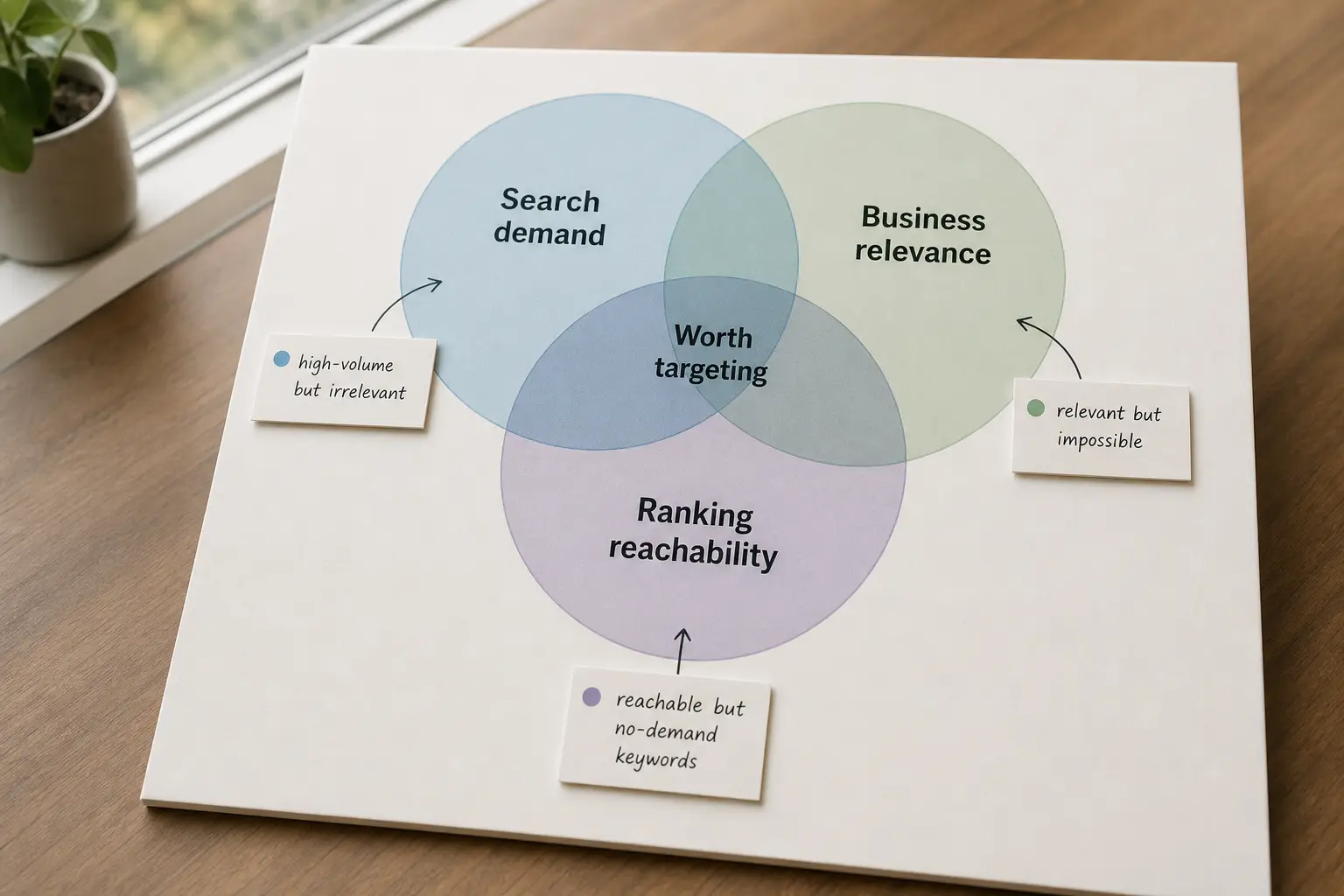
Miss any one and the keyword fails. A phrase with high volume but impossible competition wastes months. A zero-competition phrase nobody searches wastes the page. And a high-demand, winnable phrase that doesn't match what you sell brings traffic that bounces.
For a new site, reachability is usually the binding constraint. This is why beginners should weight the list toward long-tail queries: four-plus word phrases like "how to descale a dual boiler espresso machine" instead of the head term "espresso machine". Long-tail terms have lower volume individually, but they convert better, face weaker competition, and add up across dozens of pages.
How do you find your first seed keywords?
Seeds are the small set of broad topics your site is genuinely equipped to cover. Start with the topics tied directly to your products, services or expertise, then add more only when each represents a distinct search need. You already know most of them. Write down the problems you solve, the products or services you offer, and the questions people ask you before they buy.

Take a home-espresso blog as a running example. Seed topics might be: espresso machines, grinders, milk texturing, coffee beans, machine maintenance, dialling in a shot. Each seed is a doorway into hundreds of specific queries, not a keyword you target directly.
Three fast ways to pull seeds you would have missed:
- Google autocomplete and "People also ask": Google autocomplete and People also ask can reveal wording and related questions that Google considers relevant. Treat them as discovery prompts, not as a frequency-ranked list or proof of monthly demand.
- The "searches related to" block at the bottom of a results page.
- Your own site search and support inbox, if you have them: the exact wording of real questions.
How do you expand seeds into a full keyword list?
Feed each seed into a keyword source and collect every variation, then dedupe into one spreadsheet. Free starting points include Google autocomplete, the related-searches block, and question aggregators. Paid tools (any mainstream keyword platform) give search volume and difficulty scores, which speeds the later scoring step.

For each seed, capture four columns as you go: the keyword, its rough monthly search volume, a difficulty signal, and the intent (you'll fill intent in the next step). Expanding "milk texturing" might produce: "how to steam milk without a wand", "microfoam vs froth", "best milk for latte art", "steaming milk temperature". One seed, four distinct pages' worth of intent.
Aim for breadth here, not judgement. At this stage, retain relevant variations even when some may later be merged. Remove duplicates and weak ideas after you have classified their intent. The number of suggestions varies widely by topic and tool. Keep expanding until new searches mostly repeat ideas already on the list; that is a more useful stopping rule than chasing a fixed keyword count.
How do you group keywords by search intent?
Sort every query into one of four intent types, because intent decides what kind of page ranks before volume matters at all.
Informational
- What the searcher wants: To learn or solve
- Example query: "why is my espresso sour"
- Page type that ranks: Guide or article
Commercial
- What the searcher wants: To compare before buying
- Example query: "best espresso machine under 1000"
- Page type that ranks: Comparison or review
Transactional
- What the searcher wants: To buy or act now
- Example query: "buy Rancilio Silvia"
- Page type that ranks: Product or service page
Navigational
- What the searcher wants: A specific brand or page
- Example query: "Rancilio Silvia manual"
- Page type that ranks: Brand's own page
The current results show which interpretations and page formats Google is favouring for the query. Some result pages contain mixed intent, so note the dominant format as well as any meaningful alternatives. If the results for your keyword are all buying guides, a thin definition post will not rank there no matter how good it is. Check the current results for any keyword you're unsure about: the page types already ranking tell you the intent Google has assigned. Checking the results before drafting prevents a common mismatch: creating an article when Google is primarily returning product, comparison or category pages.
How do you judge keyword difficulty on a new site?
Difficulty is how hard it is to reach page one, and you can read it without a paid tool by examining who ranks now. Search the keyword and look at the top ten results for three signals: are these established, high-authority sites or smaller ones like yours; do the ranking pages actually answer the query well or leave gaps; and how many results are forums, older posts, or off-target pages you could beat.
Paid difficulty scores (a 0 to 100 number on most platforms) are a useful shortcut, but treat them as a starting filter, not the verdict. A term scored "medium" can still be winnable if the pages ranking are weak, and a "low" term can be locked up by one dominant result. Use the tool score to filter a large list, then inspect the live results before committing resources. The manual review adds context that a single difficulty score cannot capture.
For a newer site, look for result pages where several ranking pages are genuinely comparable to yours and where the existing answers leave a clear gap. Judge the pages themselves, not domain size alone, and record what your page could improve before assigning priority.
How do you prioritise which keywords to target first?
Score each keyword group against four checks and record the evidence behind each, so the ranking is repeatable rather than a gut label.
Business relevance
- Question to answer: Does ranking for this lead toward a sale, subscriber or clear next step?
- Evidence to record: The page or offer it would send readers to
Intent fit
- Question to answer: Can you build the page type the current results reward?
- Evidence to record: The dominant format in the live results
Evidence of demand
- Question to answer: Do enough people search it to justify a page?
- Evidence to record: The volume figure, or the autocomplete and related signals you saw
SERP reachability
- Question to answer: Are the ranking pages ones you could realistically beat?
- Evidence to record: Notes on the top results and the gap you would fill
Treat relevance and intent fit as gates, not bonus points. If either fails, do not target the query. If both pass, compare demand with reachability: prioritise a group when the live results contain pages you can plausibly improve on and you can name the useful next action for its visitors. Record the reason in one sentence so another editor can reproduce the decision.
A group that passes all four is a high priority; one that fails relevance or reachability drops down regardless of volume.
Edge case: a low-volume query with strong relevance ("how to descale a dual boiler espresso machine") usually beats a higher-volume query whose result format you cannot credibly match. Take "espresso machine": if the results are retailer category pages and you have no product to sell, the demand cannot rescue a keyword whose page type you have no way to supply. Weigh the two by asking which page you could actually build to compete, not by volume alone.
A workable order for a new site:
- Long-tail, low-competition, high-relevance informational and commercial terms. These are your early wins and they build topical authority.
- Mid-tail commercial terms once a few of the above rank, signalling the site is credible on the topic.
- Head terms last. Broad, high-volume phrases need authority you earn from the first two tiers first.
Score each keyword group high, medium, or low on priority and start with a batch of high-priority terms that cover one seed topic thoroughly. Concentrating on one topic can create stronger internal linking and more complete coverage than publishing isolated articles across unrelated subjects. It does not guarantee rankings, so review page quality, indexing, links and actual search performance before moving to harder terms.
The table below is an illustrative mapping exercise, not a live SERP study. For each query, record the date checked, the dominant page formats, recurring subtopics, obvious content gaps and whether your site can credibly produce the required page. Only then make the page decision.
"why is my espresso sour"
- Illustrative intent: Informational
- Result pattern to verify: Troubleshooting guides
- Gaps and the page you could build: Assess after manually reviewing the results and noting missing causes
- Page decision: Include in a sour-espresso troubleshooting guide
"best milk for latte art"
- Illustrative intent: Commercial comparison
- Result pattern to verify: Comparison articles
- Gaps and the page you could build: Check the comparison pages for a gap you can fill, such as untested milks
- Page decision: Give it a separate page
"steaming milk temperature"
- Illustrative intent: Informational sub-question
- Result pattern to verify: Overlaps with milk-steaming guides
- Gaps and the page you could build: Same reach as the main steaming guide; covers one sub-question
- Page decision: Cover as a supporting section within the main steaming guide
The pattern to notice: two informational queries land in different places because one is a whole troubleshooting need and the other is a sub-question of an existing guide, while the commercial query earns its own page because its result set diverges from both.
How do you map keywords to pages?
Assign one primary intent to one page, then cluster the closely related variations under it. Overlapping pages become a cannibalisation problem when they serve the same purpose and repeatedly compete for the same result. Before merging or redirecting anything, compare their intent, ranking queries, backlinks and conversions; distinct pages can coexist when each serves a different need.
Group your keywords so that everything a searcher with the same intent would want lives on one page. "How to steam milk", "steaming milk temperature", and "steam milk without a wand" are the same intent and belong on a single guide, each phrase used naturally in the copy. But "best milk for latte art" is a different question and earns its own page. Once mapped, the closely-related terms become your H2s and subtopics on that page.
This mapping doubles as your content plan. Each row becomes a page brief: the primary keyword, the intent, the page type, and the supporting terms to cover. Add internal links where one page helps the reader take the next logical step. Use anchor text that describes the destination, and make sure the main topic page links to its supporting guides and receives relevant links back from them.
Common mistakes that waste a keyword list
- Chasing volume, ignoring intent. A 10,000-search head term you can't rank for is worth less than ten 200-search phrases you can.
- Writing before checking the current results. If buying guides rank and you publish a definition, you built the wrong page.
- One post per seed topic. Depth on one topic beats one thin page across ten topics.
- Ignoring difficulty on a young site. New sites often have a better chance when the current results include weaker or incomplete pages. Start with those opportunities, then use performance data to decide whether broader terms are realistic.
- Letting two pages target one query. Complete the page map before drafting so writers can see which search need belongs on each page and where related queries should be consolidated.
Frequently asked questions
How many keywords should a beginner target per page?
Choose one primary search need, then include as many close variations as are useful for answering that need completely. Do not add phrases merely to reach a target count, and do not spread unrelated intents across a single page.
Do I need a paid keyword tool to start?
No. Google autocomplete, related searches, and the "People also ask" box give you seed expansion and intent signals for free. Paid tools mainly save time on volume and difficulty scoring once your list grows.
What is search intent mapping?
It's the step where you sort each keyword by what the searcher wants (learn, compare, buy, or find a specific page) and then match one page per intent. Intent decides the page format that can rank, so it comes before you judge volume or difficulty.
How is keyword research different for AI search?
The core process is the same, but AI answer engines reward pages that answer a specific question directly and completely. Grouping keywords tightly by intent and answering the exact question up front helps both classic rankings and visibility in AI Overviews.
When should I target competitive head terms?
After you've ranked for a cluster of long-tail terms on the same topic. Those early wins build the topical authority that broad, high-volume terms require.
Your first keyword map: a one-topic checklist
Choose one seed topic. Export or record its query variations. Mark the dominant intent and current result format for each. Merge queries with the same need, separate those with different result patterns, and assign each cluster to an existing or planned page. Record the internal links each page should receive before drafting.
This guide covers keyword selection and page mapping. For the wider sequence that includes technical SEO, content creation and measurement, continue with the structured SEO learning path at SEO 24x7.