⚠️ NEEDS REVIEW — do not publish as-is. Auto-generated and flagged by Agentic OS: Held after 2 rewrite attempt(s): verdict=minor_fixes. Needs a human. Fix the flagged issue(s) and delete this note before publishing.
Build a Public Track Record: Why Where You Publish Your Work Matters
Where you publish your SEO work determines whether it can ever be found, cited, or verified by anyone who isn't already in the room. Work restricted by login or client access is generally unavailable to public search crawlers and public answer-engine retrieval; unless you later republish an authorised version on the open web, people outside that space are unlikely to discover or verify it. An indexed page attached to your name is retrievable years later, quotable by a language model, and checkable by someone deciding whether to hire you. The same analysis, in two different places, produces two completely different career outcomes.
Key takeaways
- Closed platforms are structurally unindexable: the issue is access control, not content quality.
- Attribution matters as much as indexation. Unsigned work can't accrue to you.
- AI systems can only cite sources they can retrieve, and public, crawlable pages are more likely to be retrieved than access-gated ones.
- A public case study gives a reviewer something an unpublished body of work cannot: a specific method, result and set of limitations they can inspect directly.
- Publishing under a stable handle on an indexed domain gives your work a permanent, linkable address.
Why can't search engines or AI engines see work published in closed communities?
Because they never receive it. A crawler requests a URL over HTTP and gets back either content or a login wall. Slack workspaces, private Discord servers, gated Facebook groups, members-only forums and LinkedIn feeds behind auth all return the wall. There is no clever workaround: this is the platform working exactly as designed, and it is often the right design for candid discussion.

The consequence is easy to underestimate. A careful piece of diagnostic work, written up properly and posted in a private group, can get plenty of engagement inside that room and still go nowhere outside it. Later, when someone searches for that exact failure mode, they will not find the write-up. An AI assistant asked the same question will not surface it. A hiring manager reviewing an application will not encounter it. The work can be excellent and its reach can still end the day the thread scrolls away.
This is a structural argument, not a criticism of any particular community. Private spaces are good for asking questions you would not ask publicly, for sharing things under NDA, and for getting fast feedback from people you trust. They are simply the wrong destination for the work you want to be known for.
How does indexed, attributed work compound?
A published page keeps working after you stop. Three mechanisms drive it, and they stack.
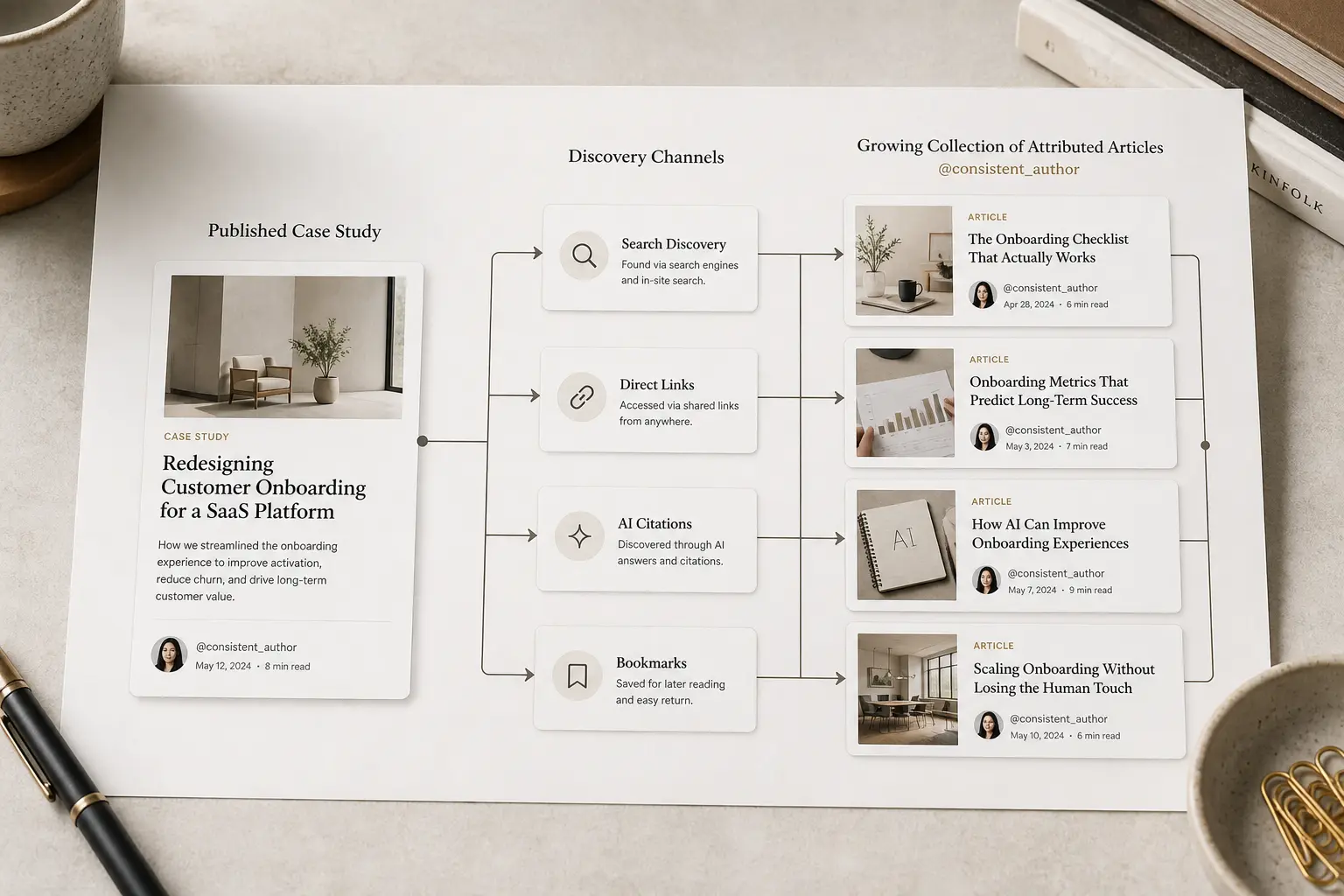
Retrievability. The page exists at a URL. Anyone, at any time, can reach it: a search result, a link in a reply, a citation in an AI-generated answer, a bookmark someone saved eighteen months ago.
Attribution. Your name or handle is attached to the analysis. Search systems increasingly model authorship and entities rather than just strings of text, and consistent authorship across multiple published pieces on a topic is the raw material that modelling needs. Google's own guidance on creating helpful content asks whether content is presented in a way that makes its source, expertise and authority clear.
Accumulation. Piece two benefits from piece one. Someone who reads a good technical write-up looks for what else you have published. Where the earlier work sits at a stable, linkable address, it can be found; where it sat in a chat thread, there is nothing to find. Ten published case studies under one handle read as a body of work. Ten Slack posts read as ten Slack posts.
What does this mean now that answer engines sit between searchers and pages?
Public access does not guarantee inclusion in an AI answer, but private access usually prevents public retrieval in the first place. This page is about where you publish; the mechanics of what makes a page worth citing are covered in our guides to how to earn visibility in Google AI Overviews and AI answer engines and how to get cited by ChatGPT. The short version: original, first-hand write-ups are the material those systems have the least of, and they can only draw on it if it sits somewhere they can reach.
Which venues actually build a track record, and what does each cost you?
The venue that builds a track record fastest is the one that is indexed, attributes the work to you by name, and gives it a permanent address; most venues fall short on at least one of the three.

Closed Slack or Discord
- Indexed: No
- Attributed to you: Inside the group only
- Permanent address: No
- Main trade-off: Great feedback, zero reach beyond the room
Client deck or internal report
- Indexed: No
- Attributed to you: Often stripped
- Permanent address: No
- Main trade-off: The client owns it; you frequently cannot show it
Social feed post
- Indexed: Partially, inconsistently
- Attributed to you: Yes
- Permanent address: Weak, feed-dependent
- Main trade-off: Fast distribution, poor retrieval later
Your own site
- Indexed: Yes
- Attributed to you: Yes
- Permanent address: Yes
- Main trade-off: Full control; you supply all the audience and authority
A public, indexed community platform
- Indexed: Yes
- Attributed to you: Yes, under your handle
- Permanent address: Yes
- Main trade-off: You publish on a shared domain rather than your own
Publication durability check. Before counting a venue as part of your track record, test it directly: open the page while logged out and confirm it renders. Check whether the author name and publication date are visible on the page itself. Edit the piece and confirm the URL stays the same afterwards. View the page source for a canonical URL. Search for the exact title once indexing has had time to occur. Check whether the platform allows exporting or republishing the piece elsewhere. Passing these checks improves the piece's accessibility and your ownership of it. It does not guarantee indexing or citation by any search engine or AI system.
None of these is universally correct. Your own domain is the strongest long-term asset if you will actually maintain it, and plenty of practitioners never do: a domain with two posts and a lapsed certificate is a worse signal than no domain. A shared, indexed platform removes the maintenance and cold-start problem. The two combine well: publish on the platform, link from your own site.
What about the client confidentiality problem?
Most practitioners who publish nothing cite this reason, and it is a genuine constraint rather than an excuse. It is also more workable than it first appears.
Anonymise the client and keep the method. "A mid-size Australian retailer with roughly 12,000 indexed URLs" carries almost all of the useful signal and none of the identifying detail. Report relative change rather than absolute revenue: percentage movements in clicks or impressions, ratios, index counts. Focus the write-up on the diagnosis and the intervention, which is what readers are actually there for, rather than on the commercial outcome.
Ask. Many clients agree to a named write-up, particularly when it flatters them. Some agree on a delay of six or twelve months. Some agree to anonymised publication only. You will not know which until you ask, and the ask costs nothing.
Where a client engagement genuinely cannot be discussed, use your own properties instead. A test on your own site, a reproducible experiment, a documented tool comparison and a teardown of a public failure mode are all publishable without permission from anyone.
What makes published work read as credible rather than as marketing?
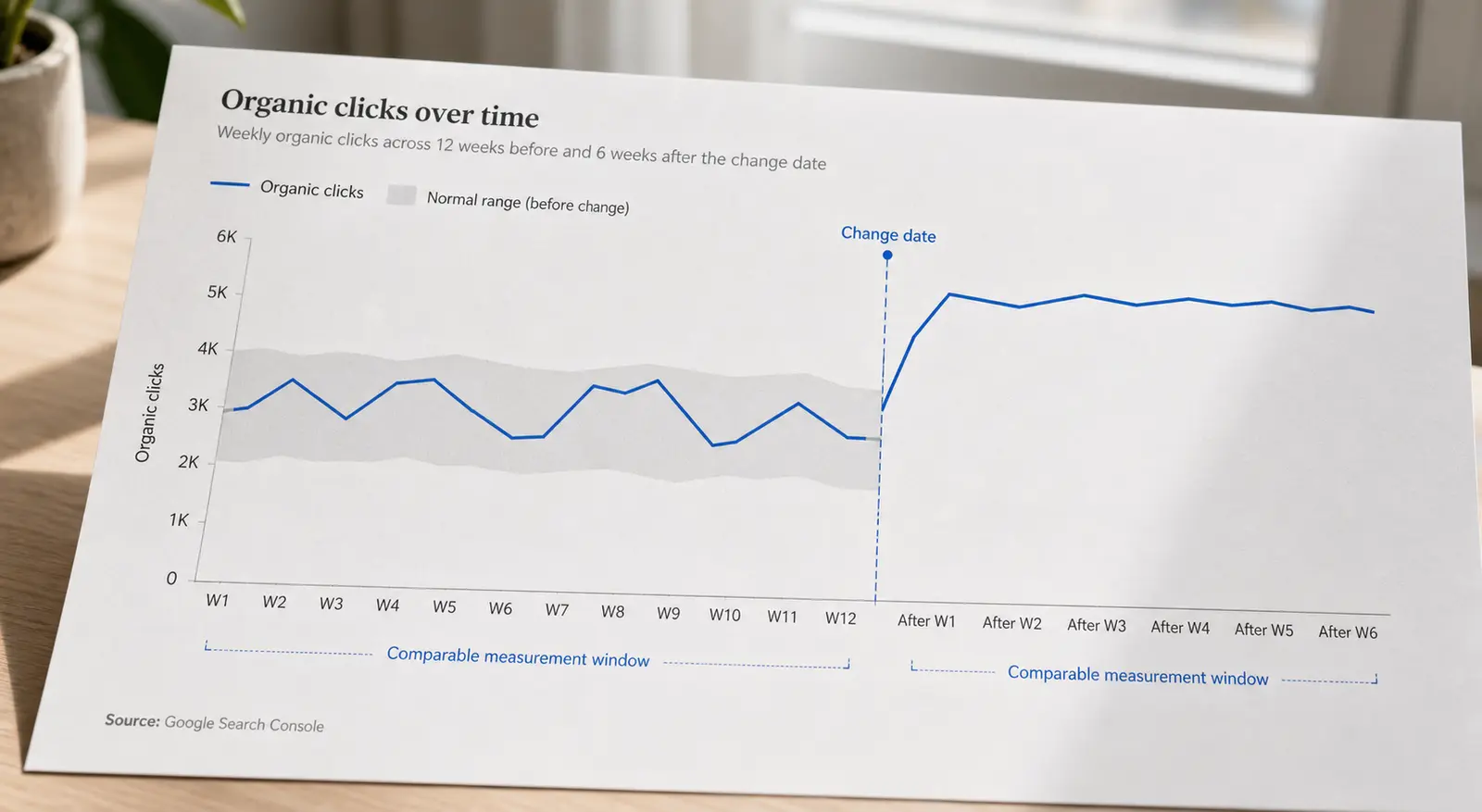
Falsifiability. The published SEO write-ups that hold up share a shape: a stated baseline, a specific change, a defined measurement window, and an honest account of what else was happening at the same time. The ones that get dismissed share the opposite shape: a percentage with no starting number, no dates, and no mention of the seasonal spike, the migration or the paid campaign that ran concurrently.
Readers in this field are practitioners. They will notice a missing control period faster than they will notice good writing. Include the confounders you cannot rule out and state your confidence limits plainly. Saying "traffic rose 30% over eight weeks, though a competitor also deindexed a large section of their site in week three" is more persuasive than the clean version, because it demonstrates that you know what would falsify your own claim. We go into the mechanics in how to measure an SEO win you can actually prove, and into the specific failure patterns in why SEO case studies get ignored.
How do you start when you have nothing published yet?
Start with work you have already done. Many practitioners already have completed analysis sitting in a folder, deck or old thread. Choose a piece that can be reconstructed accurately and published without breaching client confidentiality, and where you can most clearly show the before state, the change and the measurement.
A practical sequence:
- Choose a single completed piece of work with a measurable outcome and a defensible measurement window.
- Write the baseline first, before you write the result. If you cannot reconstruct a credible baseline, choose different work.
- Name the change precisely. "Improved internal linking" is not a method; "added contextual links from 340 category pages to 28 previously orphaned guides" is.
- State the timeframe and the confounders in the same paragraph as the result.
- Publish it somewhere indexed, under a name that stays the same across everything you publish.
- Link to it from wherever you already exist online: your site, your profile, your reply to the next relevant question.
Consistency of handle matters more than most people assume. A track record fragments when the same person appears as three different names across three platforms. Pick one and keep it.
Publish your first case study on SEO 24x7
SEO 24x7's community lets members publish attributed case studies at public URLs. Public access makes the work linkable and eligible for crawling, although indexing and inclusion in AI answers are never guaranteed. It is free and currently in beta, so tools, results and community features are provided as-is and may change.
Publishing early can help establish your handle and topic focus while the community is still growing.
Two steps, both self-serve. Claim your @handle at seo24x7.com/welcome, then publish at seo24x7.com/case-studies/new. If you want the structure worked out before you write, read how to publish a case study on SEO 24x7 first. And before you ship the page, run it through the free Page Checker to see how it scores for SEO and AI search.